|
"The purpose of the Delaware Astronomical Society shall be to encourage interest, and to advance education and scientific knowledge, in the subject of astronomy.” |
The Delaware Astronomical Society Library is committed to research the history of Astronomy in the State of Delaware.
The following projects are underway.
The 1776 Almanacs: Two Printers, Two Astronomers, One Revolutionary Year: The Delaware Astronomical Society Library America 250 Project
In 1776, two almanacs were published for readers in the Delaware Valley and on the surface they served the same purpose — calendar, weather, tides, planetary positions; yet, beneath the surface, they embodied the deepest division of the Revolutionary era.
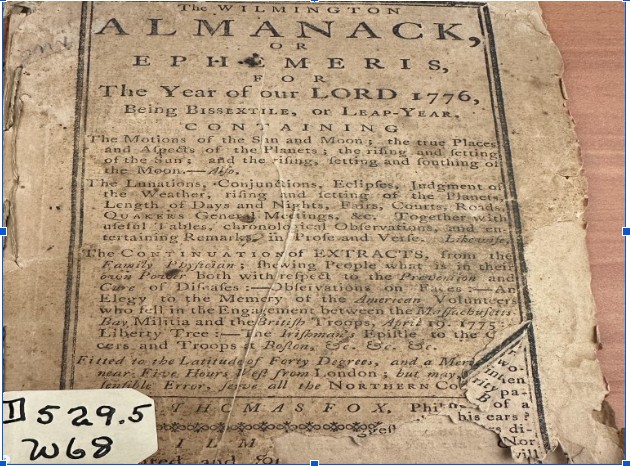
The Wilmington Almanack was printed by James Adams, Delaware's first printer and a committed Whig Patriot. Its astronomical calculations were the work of Johannes Tobler — a Swiss emigre to the Carolinas---a mathematician, musician, and astronomer who had mastered the methods of Thomas Streete's Astronomia Carolina in Appenzell Ausserrhoden, where in 1721 he founded the Appenzeller Kalender, the first periodical ever published in that canton, which is still in print today in its 305th edition. Streete himself was a remarkable figure: an Irish-born soldier, surveyor, philomath, and mathematician living in London, whose 1661 work was the first English astronomical text to present Kepler's laws in a form suitable for practical calculation, and whose tables were read, used, and cited by both Isaac Newton and John Flamsteed, the first Astronomer Royal. That a Swiss farmer in Appenzell should teach himself positional astronomy from the same book that shaped Newton's thinking, and that his calculations should then circulate through the colonial American press for decades after his death, is one of the more improbable threads in the history of science and the history of Delaware astronomy.
Driven into political exile in 1736 by the constitutional crisis known as the Landhandel, Tobler emigrated to South Carolina, where he rebuilt his life and resumed his calculations in English, for a new continent. He pre-calculated his ephemerides to the year 1800 before his death in 1765, and his data continued to circulate — under five different pseudonyms — through multiple channels simultaneously: through James Adams's Wilmington press; through Benjamin Franklin and David Hall's Philadelphia network, where Tobler's calculations appeared as the work of the fictional Richard Saunders in Poor Richard Improved; and through the German-language press of Christopher Sauer and his son in Germantown, who distributed Tobler's almanac to Pennsylvania's substantial German-speaking population under his own name, John Tobler. A single Swiss calculator, three printing networks, five pseudonyms, one colonial almanac trade.
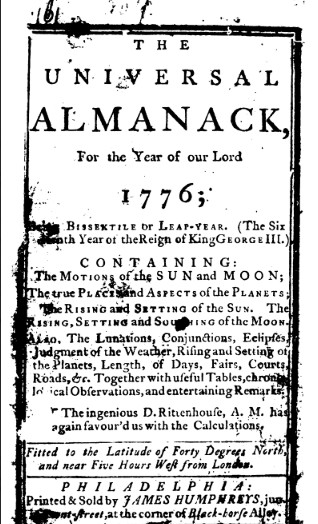
The Universal Almanack was printed by James Humphreys, a Philadelphia printer whose Loyalist sympathies would define and ultimately destroy his American career. When the British occupied Philadelphia in 1777, Humphreys collaborated openly with the Crown, continuing to print under British protection. When the British withdrew in 1778, he fled with them — eventually making his way to Canada, where he attempted to restart his life and his press. He was accused of treason against the new republic, his property confiscated, his name a byword for the wrong side of history. The astronomical calculations in his 1776 almanac were the work of David Rittenhouse — Founding Father, Philadelphia's foremost astronomer, the man who observed the 1769 Transit of Venus and calculated the Earth-Sun distance to within a fraction of a percent of the modern value, and who was at that same moment serving on the Pennsylvania Committee of Safety, designing Delaware River defences against the British, and sitting as a delegate to the 1776 Pennsylvania Constitutional Convention. A Patriot by every measure — providing his calculations to a man who would shortly be accused of treason. How that arrangement came about, and what it tells us about the tangled loyalties and commercial dependencies of Revolutionary Philadelphia, is one of the questions this research sets out to answer.
Backtesting of both almanacs against the JPL Horizons system — NASA's definitive ephemeris, has been completed for the 1762 Wilmington Almanack and preliminarily for the 1776 editions. Preliminary results are promising and will be presented in full at the 2026 meeting. The backtesting of Tobler's calculations has already established that a self-taught Swiss mathematician working from a seventeenth-century book, achieved a level of astronomical accuracy that stands up against the best modern computation. The backtesting of Rittenhouse's 1776 figures we show directly how much the intervening advances in European astronomy — Tobias Mayer's lunar tables, the first Nautical Almanac, the observations of the 1769 Transit of Venus, and the advantage of cutting edge instruments — improved on what Tobler had achieved on the Carolina frontier.
The questions this contrast raises are historical, astronomical, and deeply human. Which almanac was the more accurate? Which carried the more significant editorial texts, and what do those texts reveal about how each printer understood the crisis unfolding around him? How does the pairing of a dead Swiss exile's tables with a living American patriot's calculations — each reaching readers through printers on opposite sides of the conflict — illustrate what Ken Burns has described as the civil war within the Revolution?
One notable passage from the 1776 Wilmington Almanack is a satirical dialogue called "The Politicians" — almost certainly drawn from earlier European or colonial print culture, in the long tradition of lunar satire that stretches from Cyrano de Bergerac's Comical History of the States and Empires of the Moon to Daniel Defoe's The Consolidator. Adams, an avowed Whig, almost certainly selected it because its targets were unmistakable to any Wilmington reader in 1776. The piece features Peter, servant to a fisherman-turned-Member of Parliament from Poole, Dorset, breathlessly reporting Parliament's plans to defeat America — blockading its ports, digging a ditch across the Atlantic, setting the air on fire, lowering clouds onto American heads, and blowing up the Continental Congress by bringing Guy Fawkes back to life to tunnel under the sea. The satirical climax sends ten regiments of cavalry to the Moon to intercept a comet and use it to conquer the planets — Mars, Jupiter, Saturn, and all the rest — and bring them to England to pay taxes:
"Why, we're going to send ten regiments of horse to the moon, to lay in wait for a comet, and as she passes by they're to board her, and fire out of her tail, upon Mars, and Jupiter, and Saturn, you've heard of them, and all the rest of the stars and planets, and take them every one, and bring them to England, and make them pay taxes."
It is an eighteenth-century Mad Magazin
This piece carries an unexpected resonance as America approaches its 250th anniversary. The Artemis II mission successfully carried astronauts around the Moon earlier this year — and the juxtaposition is an apt one. The 1776 Wilmington Almanack, with its Moon tables calculated by a Swiss exile and its lunar satire selected by a Patriot printer, speaks across that distance with surprising directness. In 1776, Adams used the Moon to mock the British empire. In 2025, astronauts orbited it as the nation prepared to mark a republic's quarter-millennium.
The DAS Library America 250 Project began in 2023 with the transcription and explication of the 1762 Wilmington Almanack — Delaware's first almanac, also printed by James Adams. The 1776 transcription extends that scholarship into the Revolutionary year itself, connecting Delaware's earliest printing history to the founding of the nation. Full transcriptions of both the 1776 Wilmington Almanack and the 1776 Universal Almanack have been completed and are now being edited, with all texts sourced. A meeting will be held later this year to discuss the transcriptions and backtesting in detail and the weaponization of the printing press during the American Revolution---is politics the master science?
Lenape Astronomy Lexicon
The DAS Library maintains a lexicon of Delaware's native Lenape Indian words related to astronomy.
Delaware's First Almanac-The 1762 Wilmington Almanac
The DAS Library initiated a research collaborative and transcription project for Delaware's first almanac, The 1762 Wilmington Almanac printed by James Adams, Delaware's first printer who trained at Franklin & Hall in Philadelphia--yes, Benjamin Franklin's printing house. Address enquiries to
The Research and Transcription Project
Delaware Astronomers and Telescopes: A Survey
The DAS Librarian has initiated a comprehensive survey of astronomers connected to Delaware, along with their telescopes, sundials, instruments, and observatories. This effort spans from the observational traditions of Native American (Lenape) skywatchers, through the celestial navigation practices of 17th-century explorers and settlers from England, Holland, and Sweden, to the work of 18th-century surveyors, teachers, and gentleman astronomers.
The publication of astronomical almanacs in Wilmington during the 18th century—such as those printed by Delaware's first printer, James Adams, who was part of the Franklin & Hall printing network—reflects the early dissemination of practical astronomical knowledge to the public, including calendars, planetary motions, eclipses, and navigational data. In 1769, observations of the Transit of Venus were conducted in Lewes, placing Delaware within the broader international scientific effort to measure the scale of the solar system. Notable among Delaware observers is the Quaker Brandywine miller and mathematician, William Poole (1726–1779), who used a 12-foot refractor in Wilmington to observe the transit.
The survey also includes the 19th century, a period of significant development in Delaware astronomy. During this time, astronomy became increasingly formalized through published works and academic instruction, including professorships in astronomy at Delaware College (now the University of Delaware). The century also saw the construction of both college-based and private observatories, the rise of gentleman astronomers, the practice of amateur telescope making (ATM), and the start of early astrophotography. The history includes the acquisition, in 1836, of a 14-foot Herschelian reflector built by Amasa Holcomb, one of America's first professional telescope makers from Southwick, Massachusetts, for use at Delaware College. Observational milestones of the period include the 1882 Transit of Venus, which saw particpation from Wilmington's gentlemen astronomers in the William Harkness Survey for the US Naval Observatory.
The survey extends into the 20th and 21st centuries, documenting both professional and amateur astronomers and the cutting edge instruments in use today, reflecting the continued advancement of astronomical knowledge and activity in Delaware.
To support this initiative, a living spreadsheet has been created and will be continuously updated as data is collected. The DAS Library is also assembling a research archive of images and documents, which will be made available to researchers upon request.
Survey submissions are encouraged. Volunteers are welcome. Help us write the history of Delaware Astronomy. Please contact:
DAS Survey of Delaware Astronomers and Telescopes
North Star, Delaware: Where is it and how did it come by its name?
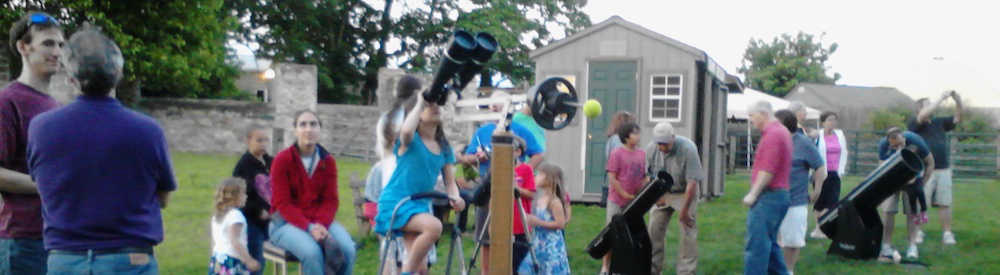
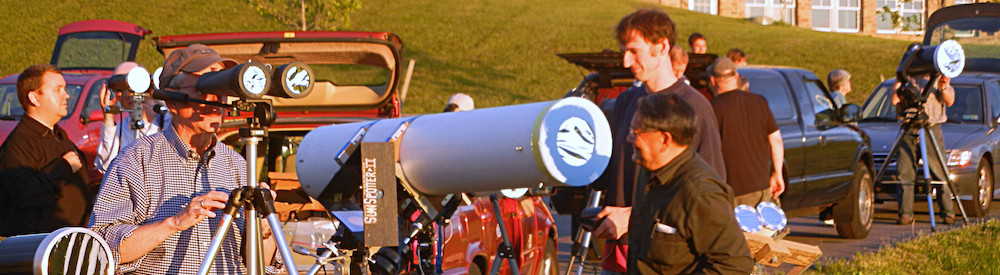
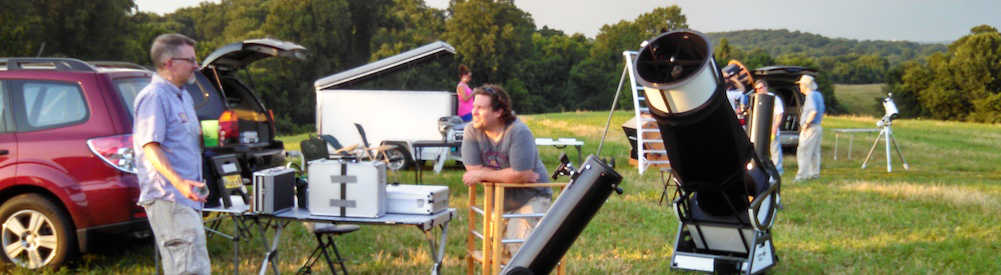
The DAS library is sponsoring a research project to learn more about the history of North Star, Delaware. The DAS members bring telescopes to the Woodside Creamery throughout the Summer and share views of the night skies with Creamery customers. Woodside's Farm dates back to the beginnings of North Star, making it such an aptly named place for Delaware Astronomers to bring their telescopes. Information about North Star and its history will be added to the project as received.
North Star Delaware Research Project
Thomas Harriot(1560-1621) and the John Shirley Papers at the University of Delaware
The DAS Library is working to transcribe important documents from the John Shirley Papers and relate the story of the trip he made by the English astronomer, Thomas Harriot, to America in 1585.
The Telescopes of Robert Frost, Poet and Amateur Astronomer
A paper will soon be published.